
An organization is the umbrella. Inside it, a company is one of the businesses you run or run ads for. There is no dashboard to switch between: the boards read every company at once, and the company shows up as a column, a filter and a split rather than as a mode you are in.
A company is a dimension, not a mode
The product's whole shape follows from one promise — manage multiple clients one dashboard, without five logins and five browser tabs — and the way it keeps that promise is by refusing to be in a mode. Three things replace the switcher other tools give you:
- Every board reads every company. Jobs, Finance and Statistics are workspace-wide by default.
- The company is on the data. A column on the tables, a saved filter you can press, a by-company split under every aggregate, and a mark on every row that carries the brand's own colour and logo, so you always know whose figure you are reading.
- A company is a place you can go — its own page, with everything that belongs to that brand alone.
A mode is worse than it looks: a board scoped to one client looks exactly like a board scoped to all of them, and nothing on screen says which. A column can be read; a mode has to be remembered.
The Companies board
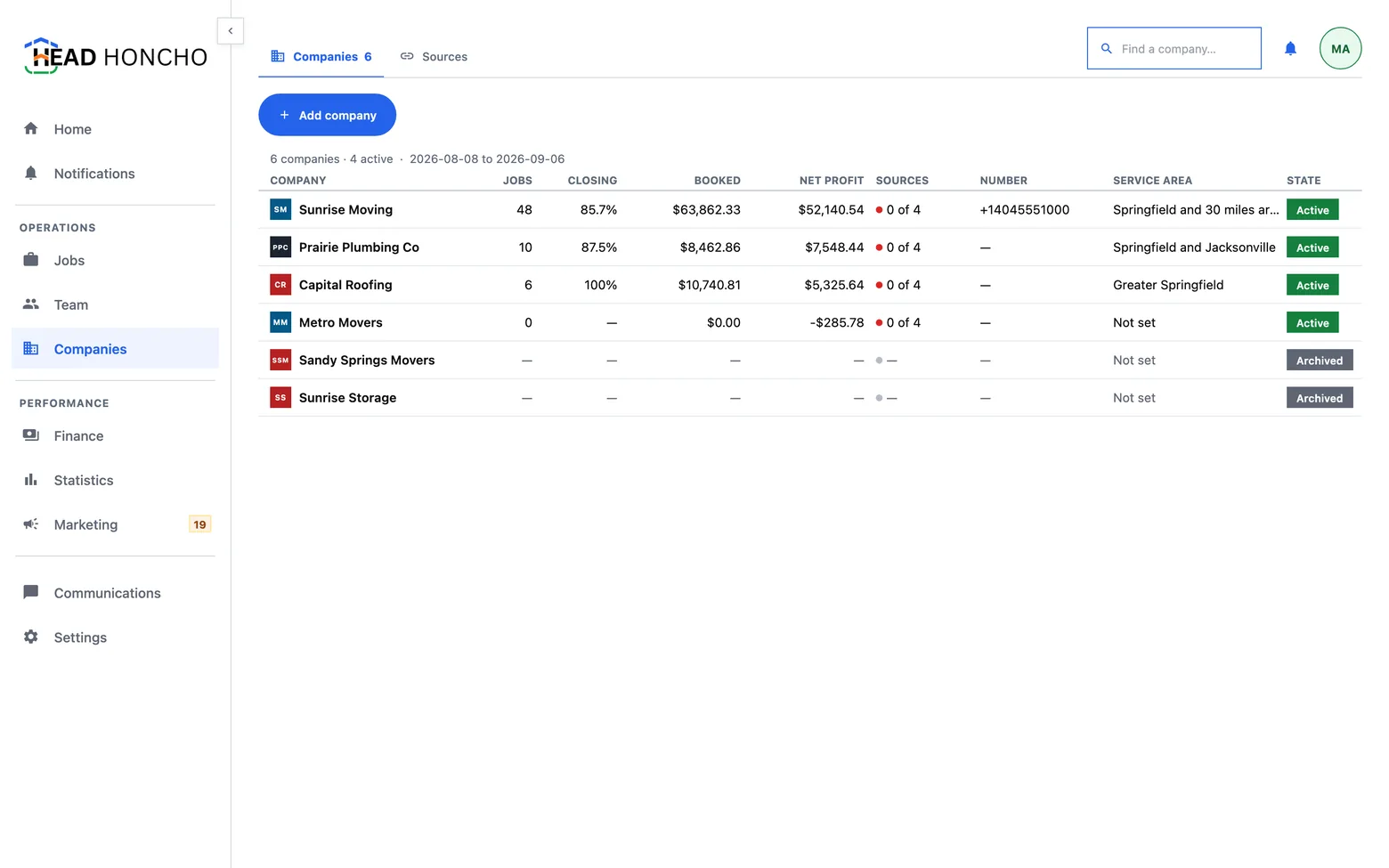
One row per company: the mark and the name, jobs, booked work, net profit, how many sources are connected, the intake number, where it works, and its state. Every row is a door into that company's page.
A row with nothing in it is the point. A company with no sources and no jobs is the most expensive client on the page, and it is exactly the one a data-driven table would drop. An archived company keeps its place and prints dashes rather than zeros, because nothing to count is not the same statement as counted nothing.
A company's own page
The page carries the boards that belong to one brand: an overview, its sources, its numbers and channels, where and when it works, its automations, its people and its reports.
The overview's figures are computed by the same code the Statistics panel runs, with one company passed in — one implementation, narrower scope. That is checkable rather than promised: the page's figure equals that company's row on the board, which equals its slice of the roll-up.
Why Sources never merges
An ad credential belongs to one company. An agency running seventeen clients holds seventeen separate grants, each into that client's own account — so “connect Google” is a question that cannot be asked of a set.
The consequence is a rule with no exceptions: a column may count, and it may not conclude. The sources matrix — companies down the side, platforms across the top — will tell you 3 of 4 connected; it will never print “Google: connected” over a portfolio where nine clients are not. Details on connecting your ad sources.
What a company owns, and what it does not
| Belongs to the company | Shared across the workspace |
|---|---|
| Its jobs, and the money on them | Your job types and job statuses — one vocabulary, so a new company opens with your words already in it |
| Its ad and call connections | The people who can sign in |
| Its business numbers and destinations | The crews on Team |
| Its hours, service area and timezone | The subscription — companies are what the meter counts, not what it bills |
| Its own page and reports | The bell: a brand's alarm has to reach you while you are looking at another brand |
Clients are shared too, and deliberately: a household can hire two of your brands, so the job carries the brand rather than the person being duplicated.
Money on a job carries a company through the job. A retainer, a van or a monthly tool does not — expenses belong to the workspace — so a company's net profit today is job profit rather than company profit. Worth knowing before that figure is put in front of a client's accountant.
Adding, copying, archiving
Adding a company is the main action on the board. What you can do to one afterwards: run a report with that company applied, run one for all of them (one file, one section per company), export, rename, archive, and copy the setup into a new company — hours, places, dispatch templates and intake formats, but never credentials, numbers, jobs or money. Setup is a pattern worth reusing; a grant into somebody's ad account is not.
Archiving keeps the row. A company that stops trading is part of the history of every job it ever ran.
Where one company is still assumed
Two places narrow to a single company, and it is worth knowing which and why:
- Marketing is a one-client board on purpose. The panel has its own company selector, because the questions it answers — what this client's ads cost, what they booked — are questions about one advertiser.
- A handful of readers fall back to one company when several are selected, rather than merging. The raw-data browser is the one you will meet: picking a single client is exact, and the fallback is documented on that page rather than left to be discovered.