
Two boards under Settings answer them. Plan is the subscription — one for the whole organization, shared by every company you run. Usage is the meter: what this month has used against what the plan includes.
One subscription, every company
HeadHoncho plans and usage sit on two boards because they answer two different questions, and conflating them is how a bill becomes an argument. The plan is what you agreed to; the meter is what happened.
The subscription belongs to the organization, not to a company. An agency running five brands holds one plan, and adding a sixth company does not add a subscription. What each plan includes, and what it costs, is on the pricing page — the plan board shows you the one you are on and what it entitles you to.
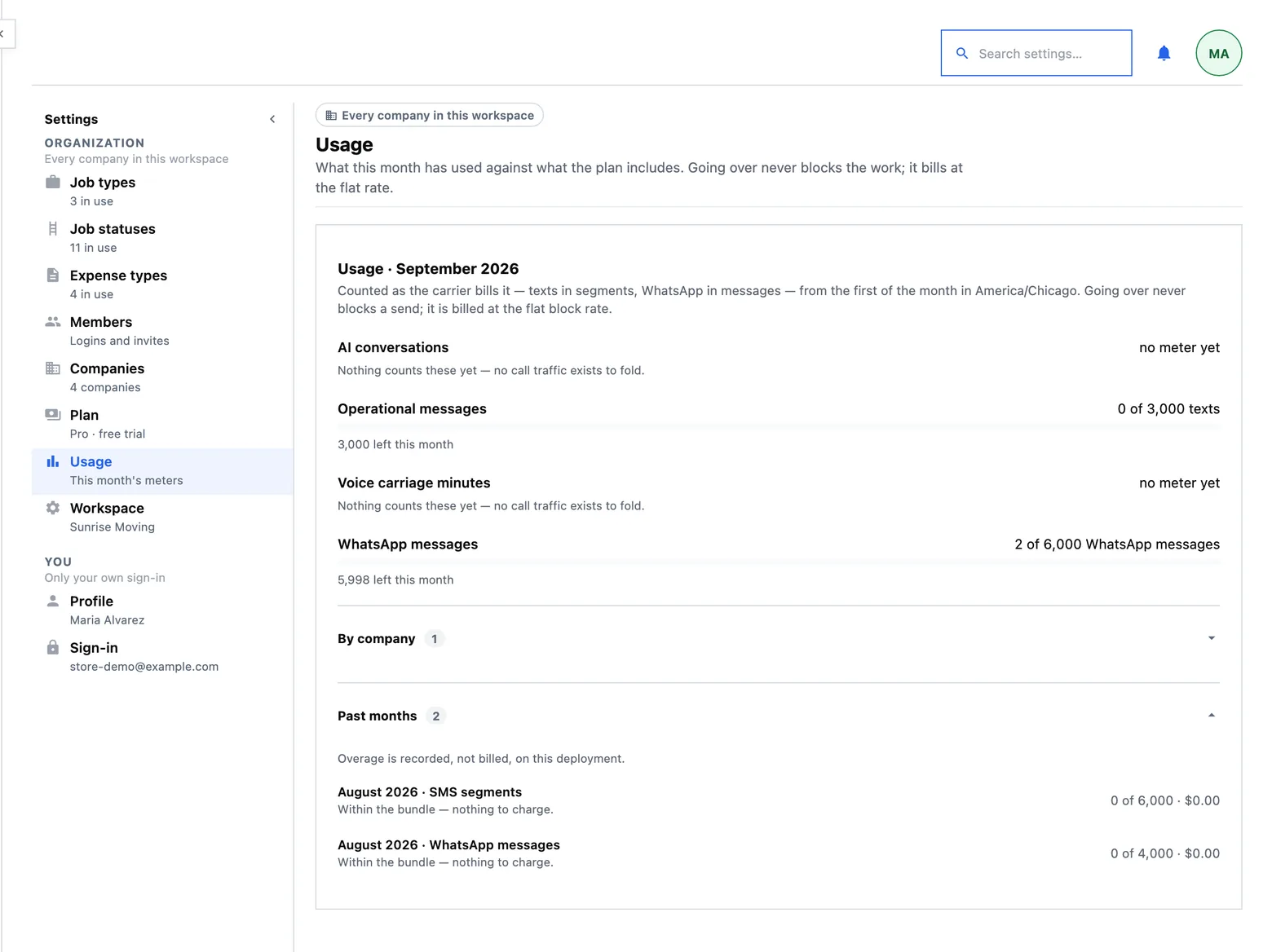
What the meter counts
The meter counts the consumables that a rail can actually count, and it is deliberately narrow:
| Unit | What counts as one |
|---|---|
| Texts | Message segments, with the carrier's own encoding-aware arithmetic — a long message is more than one segment, and the meter says so because the carrier does |
| WhatsApp messages | Whole messages, because that is the unit that rail prices |
| Call minutes | No meter yet. The row says that rather than printing a zero it cannot back |
Three rules make the number defensible:
- Only what the carrier accepted counts. A ticket that was recorded as not sent — no destination bound, no rail connected — has a body and no carrier receipt, and costs nothing, because it cost nothing.
- Inbound never counts. Somebody texting you is not your usage.
- Nothing is stored as a running total. The meter is a fold over the message rows, computed when it is asked for — which is why the strip on the Communications panel, the block on Settings and the bill cannot disagree about a number.
Messages to your crews and messages to customers are two different tables in the product and one meter here.
Reading this month
The usage board draws one row per unit: what was used against what the plan includes, as a bar and as a sentence. Under it, two sections that fold: the split by company, so an agency can see which client's messaging is doing the spending, and every closed month with the figure it was billed on.
Money prints its cents here as it does everywhere else.
When a month closes
A month closes after it has ended in your organization's own timezone — not the server's, and not the browser's. When it does, the same fold is run over that month one last time and written down as a closed period, with anything past what the plan included priced at the flat rate for that unit.
Once a month is closed, its figure stops moving. That is the whole point of closing it: a bill you can check against a number that is still changing is not a bill anybody can check.
Metered is not the same as billed
The meter always runs. Posting an overage to the payment provider is a separate switch, and the closed-month row says which happened for that month rather than leaving you to infer it. So a month can be measured, closed and visible to you without having been charged for.
This is written here rather than discovered later, because “why is there a number on this screen that is not on my card” is a much better question to have answered in advance.
Going over
Going over never blocks the work. No message is refused, no board is locked and no job stops moving because a bundle ran out — the excess is priced at the flat block rate and the usage row says so as it happens.
The reasoning is the same one that runs through the rest of the product: the thing you are in the middle of is a real business day, and a product that stops a dispatch to make a commercial point has chosen the wrong moment to make it.